Eat well

Eat well

Healthy eating guidelines

When choosing food and drinks, current healthy eating guidelines should be followed.


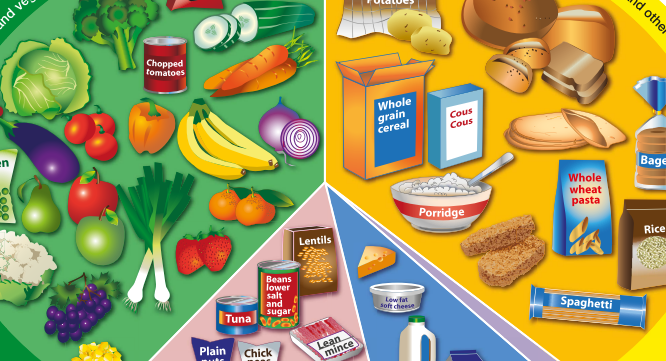
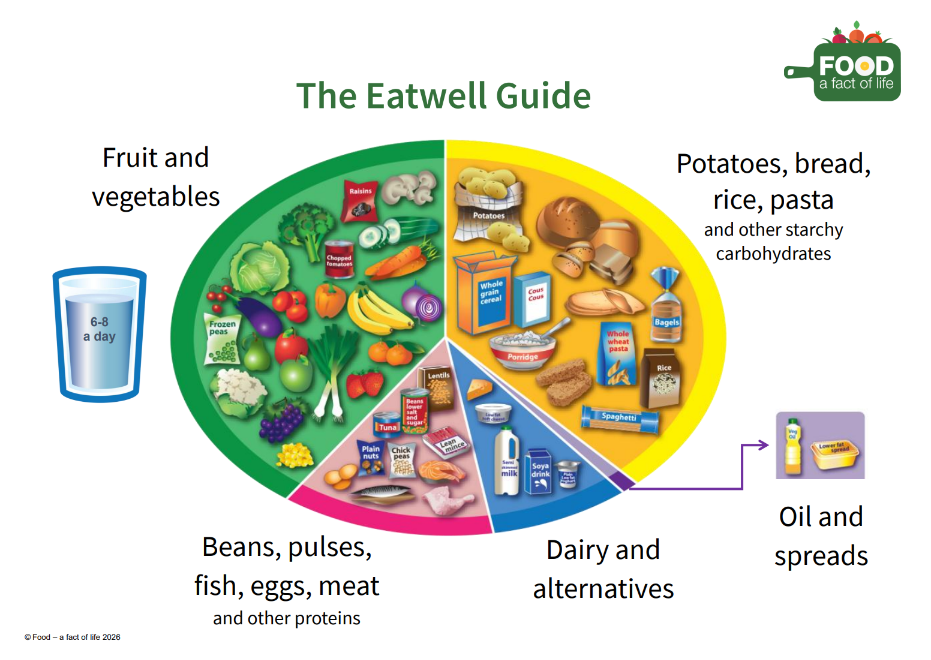
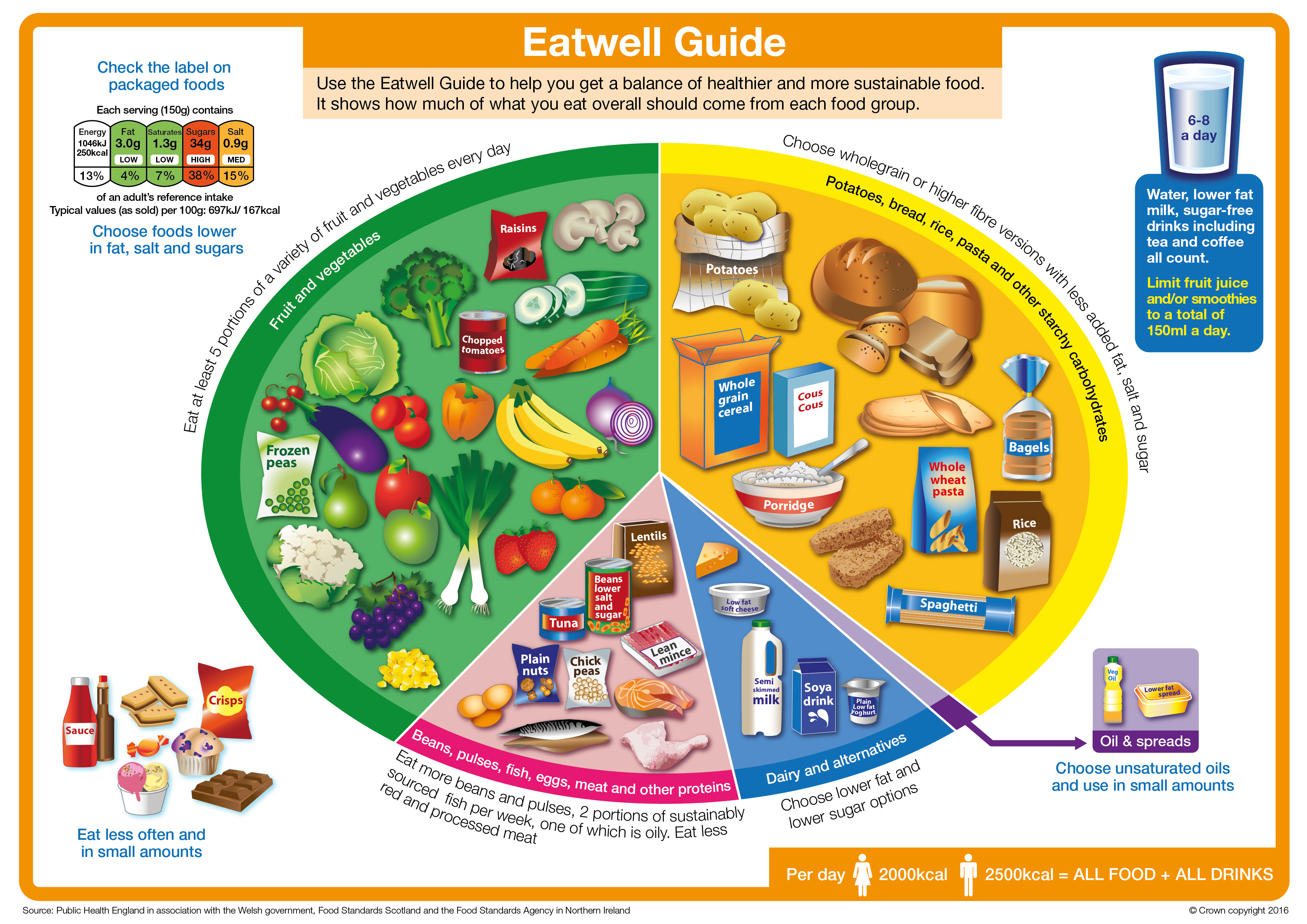
The government’s healthy eating guidelines follow a pictorial guide known as the Eatwell Guide. The Eatwell Guide divides the food and drinks we consume into five main groups and also includes information on how much we should be drinking.


It is important for pupils to be able to use this guide for their own needs and for the needs of others. This can include using food labels to help make healthier choices, modifying recipes or using the guide to help to decide the proportions of each food group that should be consumed.


For further information around a healthy balanced diet, go to the British Nutrition Foundation website. 

For other Healthy eating topics, click below:

Eat well for 3-5 years

Scroll through this carousel to see how you can teach eating well to pupils aged 3-5 years:

An image of the Eatwell Guide, the UK's healthy eating model loading=

Learning

The aim of this session is for children to:

  • recognise the Eatwell Guide;
  • name some of the food in each food group;
  • explain that we need different types of food, and 6-8 drink a day, to be healthy.


Click the arrows to see more!

 loading=

You will need:

  • The Eatwell Guide information
  • The Eatwell Guide poster (basic)
  • Food images cards - cut out, laminated (optional)
  • The Eatwell game - laminated (optional)
  • The Eatwell game food cards - cut out, laminated (optional)
  • Board or wall
  • Tac
  • Colouring pencils
 loading=

Explain and Question

Explain the picture is called the Eatwell Guide and it shows us what we need to eat and drink to be healthy. Question the children to help them engage with the Eatwell Guide. 

  • Which are the two biggest groups on the Eatwell Guide?
  • What foods can you see in these groups?
  • What food can you see in this group?
  • What food can you see in these groups?
  • What food can you see in the smallest group?
  • Where is/are the – eggs, tomatoes, bread, fish, milk?
  • Which food in the picture have you eaten today?
  • How many drinks do we need each day?
 loading=

Listen and respond

Read The Eatwell Guide information before the session. This will provide important background information to support your teaching.

Display The Eatwell Guide poster (basic). Question the children:

  • What can you see? (A circular shape, different coloured parts, a glass.)
  • What foods can you see on this picture?

Have a go

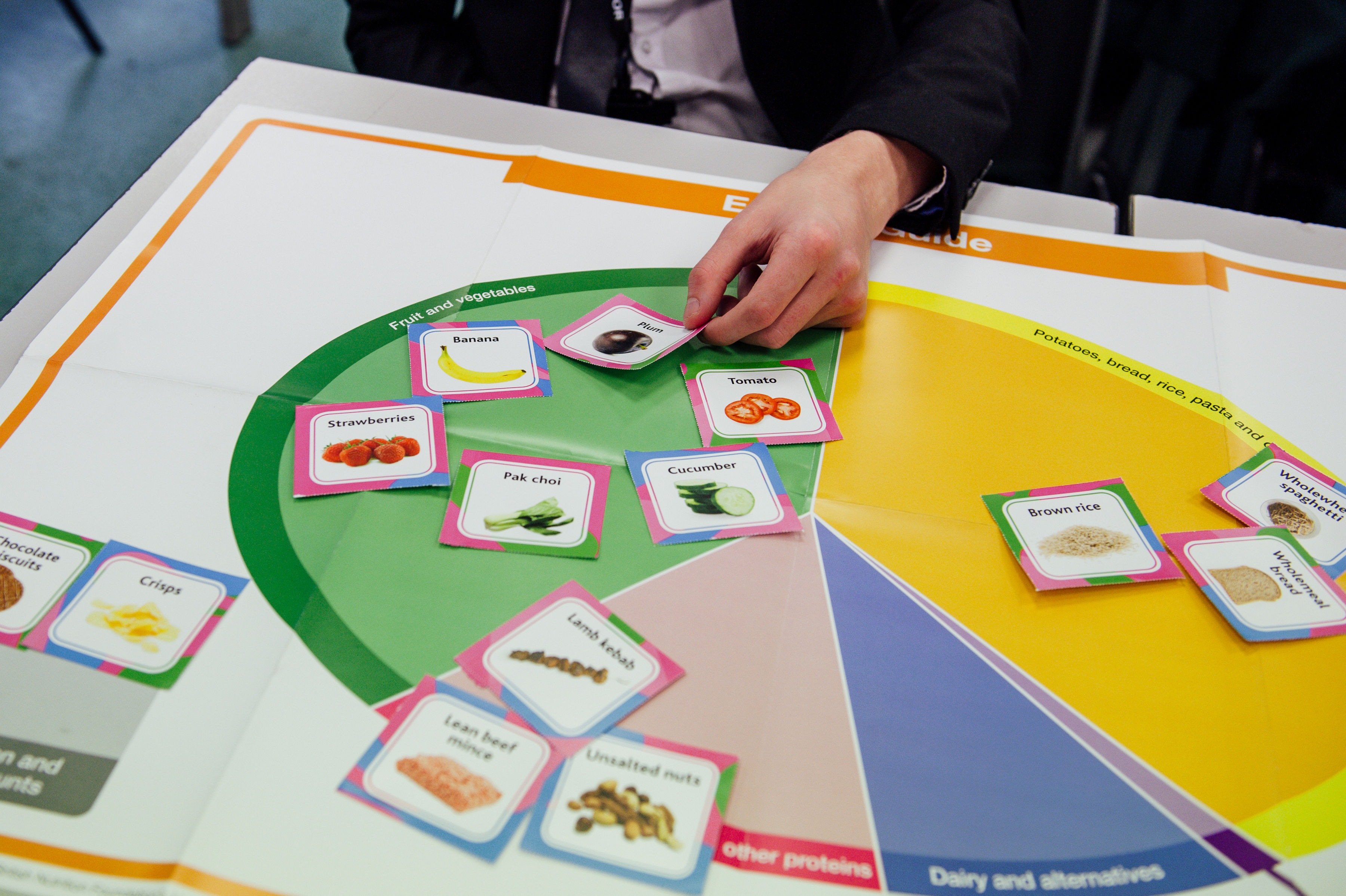
Get the children to help you sort the Food images (from Food and drinks – choices session) into the correct food groups by tacking or placing them around The Eatwell Guide poster (basic). 

 loading=

Consolidate

Play The eatwell game with the children in groups of four. 


Each child will need a copy of the board. Only one copy of The eatwell game food cards will be required. Shuffle the cards and place them face down in the middle of the table. Instruct the children to take turns to take a card, if they are able to place it on their boards, they can keep it, if not, it must be returned to the bottom of the pile.


The first child to fill their board wins the game and can help a friend until all the boards are filled.

Resources for 3-5 Years

Food choice for 3-5 years

Scroll through this carousel to see how you can teach about food choice to pupils aged 3-5 years:

 loading=

Learning

The aim of this session is for children to:

  • name a selection of different food;
  • express opinions about different food;
  • explain that different people often like to eat different food.


Click the arrows to see more!

 loading=

You will need:

  • Food images cards
  • My food book
  • Cut and stick foods
  • Scissors
  • Glue
  • Colouring pencils
 loading=

Listen and respond

Talk about eating and drinking. Question the children:

  • What have you had to eat today?
  • What have you had to drink?
  • What else do you think you might eat and drink today?
  • What food and drinks do you like?
  • Do we all like the same food and drinks?
  • What do your family and friends like to eat and drink?
 loading=

Have a go

Show the children the Food images cards one at a time. Ask the children to name the image and then ask them to respond with a thumbs up for I like it, thumb sideways for it is ok and thumbs down for I do not like it.  Ask some of the children to explain their reasons.


Focus more heavily on why children enjoy different foods, rather than their dislikes. Reinforce that different people like different food and drinks. Ask the children to talk about some of the food and drinks their friends and families like. You may wish to have examples of food for children to handle. 

 loading=

Consolidate

Provide the children with copies of the My food book, or just the third page entitled ‘I like this food’, and copies of the Cut and stick foods. Ask the children to select three foods they each like from the images and cut and stick these onto the page.


Alternatively, you could provide the children with a selection of magazines that contain different foods and they could cut and stick these onto the page or on a large sheet of paper to create a display.

 loading=

Extension

Provide children with the, ‘My_______ likes___________’, page from the My food book. Task them to choose two family members or friends and draw, or cut and stick, images on this page to show the types of foods their two chosen people like. You can write the name and food in the spaces provided. Reinforce that different people often like to eat different foods.

Food choice resources for 3-5 Years

Eat well for 5-7 years

Use the four activities below to run sessions for pupils aged 5-7 years in your classroom! You can find more activity ideas and related resources below.

Before this session, read The Eatwell Guide information. This will provide useful background detail about The Eatwell Guide. You may also wish to take a look at The Eatwell Guide videos. 


Using The Eatwell Guide presentation (5-7), ask the children to look at the image of The Eatwell Guide and tell you what they can see. Encourage them to notice that:

  • there are five food groups;
  • they are different colours and contain different foods;
  • the groups are different sizes;
  • there is a glass showing how many drinks are needed.

Help the children engage further with the Guide by asking them to name food they can see that they have tried before.   


Explain to the children that the food we eat can be sorted into five groups. Ask if they can suggest what the groups might be called by looking at the types of food they contain. After you have taken one or two answers for each group, tell the children the food group names:

  • Fruit and vegetables;
  • Potatoes, bread, rice, pasta and other starchy carbohydrates;
  • Beans, pulses, fish, eggs, meat and other proteins;
  • Dairy and alternatives;
  • Oil and spreads.

The five food groups are shown individually on the Five food group cards. You may like to use these as flash cards to test if children can remember the group names or these could be displayed.

Display The Eatwell Guide poster (basic) at an accessible height for the children. From The Eatwell Guide food cards, select a food for each of the five groups. Show one card at a time and ask a child to attach the card to the poster by the correct food group. Work through the five cards and then repeat the activity a few more times to help embed where different food belongs on The Eatwell Guide.


Cut along the perforated lines on the Food selection worksheet to create five strips of food. The children will need a strip each so you will need multiple copies of this sheet. Give each child a copy of The Eatwell Guide worksheet and a strip of food. Task the children to cut and stick the food into the correct groups on their worksheet.  


Children could place the cut outs in position so they can be checked first. When they have attached all the images, they can draw other food in the food groups on their worksheet. You may wish to have The Eatwell Guide poster (basic) available for reference.


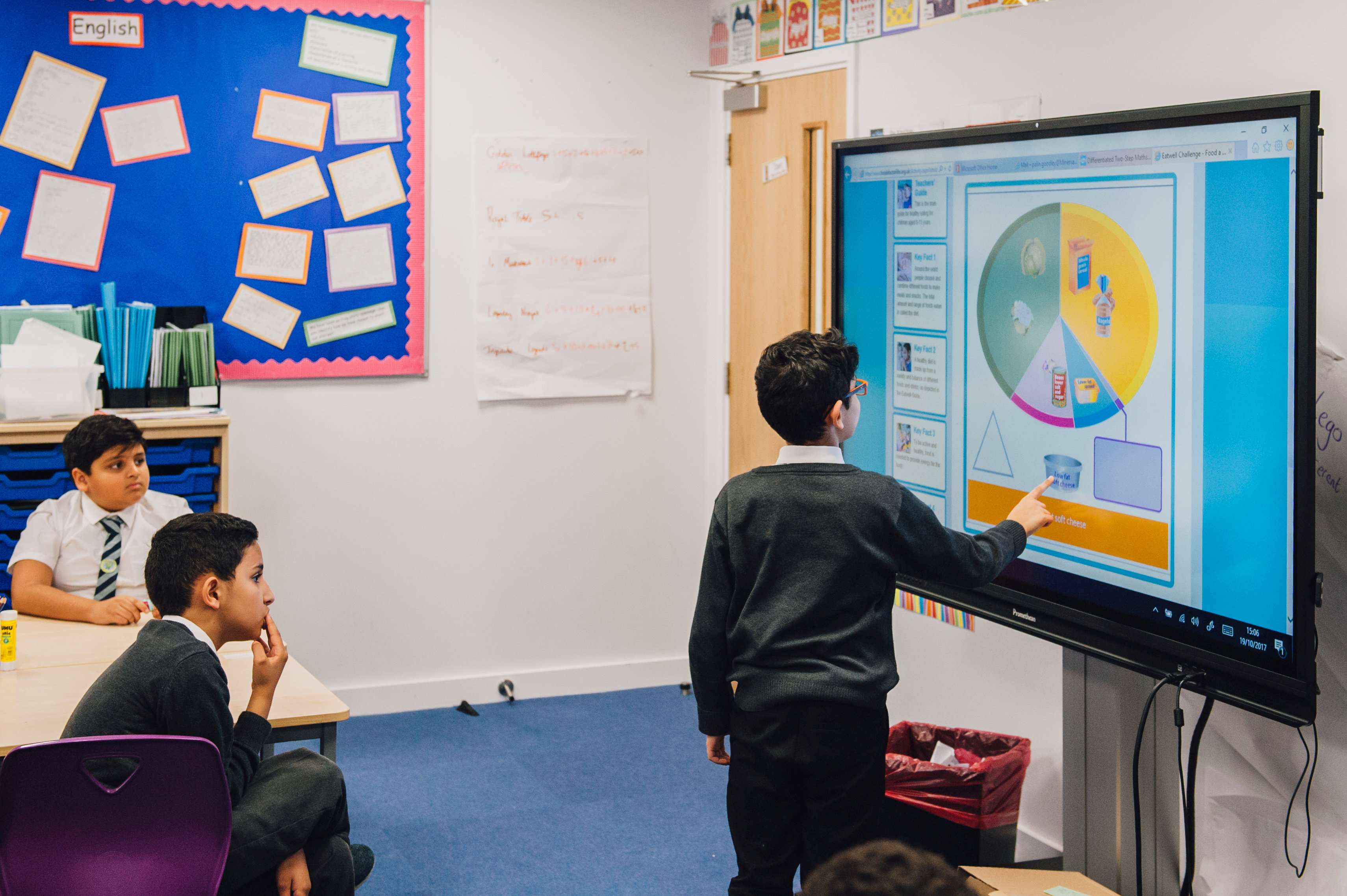
Try the Eatwell Challenge interactive activity/game.

Show children The Eatwell Guide poster (basic) or The Eatwell Guide presentation (5-7). Question them about the size of the food groups:

  • Which are the largest groups?
  • Which is the smallest group?
  • What does this mean?

Explain that this shows us which groups we should eat more or less. Check that the children can identify the larger groups from which we should eat more and the smaller groups from which we should eat less.


Explain to the children that to stay healthy we need to eat a variety of food from within the four main food groups shown on The Eatwell Guide.  The four main food groups are:

  • Fruit and vegetables;
  • Potatoes, bread, rice, pasta and other starchy carbohydrates;
  • Beans, pulses, fish, eggs, meat and other proteins;
  • Dairy and alternatives.

Only a little is needed from the Oil and spreads group, e.g. a little spread on a sandwich, a little oil for cooking.


Explain to the children that some food is not needed for health and ask if they can give any examples.  Explain that food such as chocolate, crisps, cakes, ice cream and sweets are not needed. These types of food are often high in fat, salt and sugar so if they are eaten it should only be occasionally and in small amounts.


Set the children the challenge of planning a healthy lunch that includes food from the four main food groups of The Eatwell Guide. They can use the My lunch worksheet or create a painting or collage of the lunch.

Show the children the Fruit and vegetable food group using The Eatwell Guide presentation (5-7) The Eatwell Guide poster (basic) or Five food group cards. Explain that you are going to look closely at the Fruit and vegetable group. Ask the children to name the fruit and vegetables they can see.


Discuss with the children what they think should be eaten from this group each day. Tell the children that everyone should eat at least five portions* of fruit and vegetables every day. Variety is important.


Ask the children what they like in this group and what fruit and vegetables they ate yesterday.


Explain to the children that all different types of fruit and vegetables count, for example:

  • fresh;
  • frozen, e.g. frozen peas;
  • dried, e.g. raisins;
  • canned, e.g. sweetcorn;
  • juice, e.g. orange juice.

Draw a character on the board. This might be a character from a book or television programme with which the children are familiar. Ask the children to help you plan how the character can eat at least 5 A DAY. Note what the character will eat and when.


  • As a rule of thumb, a portion is what fits into the palm of a hand. Juice/smoothies should be limited to a combined total of 150ml per day. For dried fruit, an adult portion is 30g so a child’s portion would be a little less. Dried fruit only counts as one portion of 5 A DAY. Dried fruit can stick to teeth, which may lead to tooth decay, so it’s best to keep dried fruit to mealtimes and not between meals.

Organise the children into groups of five. Give each child in the group a copy of the Fantastic folding 5 A DAY worksheet. Explain that by working together, they are going to plan the 5 A DAY for the character (discussed earlier in the session) for Monday through to Friday. Allocate a day of the school week to each child in the group of five. Each child should write the day of the week and character’s name on the top of the sheet and then fold this section over (backwards) along the dotted line. They should then pass the sheet to the person to their left who will write or draw the first 5 A DAY fruit or vegetable in section one. The sheet is then folded backwards again and passed to the next person who will repeat this and so on until five fruit and/or vegetables have been recorded and the sheet passed back with the original author. The children can then unfold the sheet they originally started and read out the 5 A DAY the character will have on that day of the week.


Discuss the 5 A DAY that has been planned for the character for each day:

  • Is there a variety or are their duplications within a day?
  • Is there a good mix of fruit and vegetable or is it all fruit or all vegetables?
  • Would they swap any of the options to get a better variety?

Look at the week as a whole for the character and consider the same questions. In addition, does the week include fresh, frozen, canned, dried and juiced varieties of fruit and vegetables?


Summarise for the children that we all need to each at least 5 A DAY, every day and this should be a variety of different fruit and vegetables.
Further activities

  • Create displays about the five food groups in the classroom. You could use clean, empty food packaging to help.
  • Plan a series of cooking sessions to promote the four main food groups, for example:
  • Fruit and vegetables: fruit salad, fruit kebabs, coleslaw;
  • Potatoes, bread, rice, pasta and other starchy carbohydrates: bread rolls, rice salad.
  • Dairy and alternatives: dips;
  • Beans, pulses, fish, eggs, meat and other proteins: mackerel pate.
  • Create a 5 A DAY rainbow display with images/photos of different fruit and vegetables grouped by colour in rainbow stripes.

Eat well resources for 5-7 Years

Food choice for 5-7 years

Use the three activities below to run sessions for pupils aged 5-7 years in your classroom! You can find more activity ideas and related resources below.

Talk to the class about their favourite food and their reasons for liking the food.


Ask the children about food they do not like and ask for their reasons. Encourage the use of new vocabulary and all the senses (i.e. sight, touch, hearing, smell and taste) when they explain their reasons. Show or display the Sensory vocabulary cards to support. 


You may wish to use the I like that presentation to introduce this topic. If used on an interactive whiteboard, you can record the children’s answers.


Task the children to complete the Food and drinks I like worksheet. Children can list or draw the foods.


Explain to the children that the food they like now might change as they get older. Have the children already noticed they now like a food they didn’t in the past? Task the children to speak to an adult at home to find out if they now enjoy any food they disliked as a child.

Talk to the children about what they eat and drink at different times of the day, e.g. breakfast, lunch, evening meal, snacks. Use the Mealtimes presentation to support the discussion.


Task the children to record what they eat and drink throughout the day on the Mealtimes worksheet. They can draw or write their responses.


Explain that we need to eat regularly during the day. Ask the children whether they can remember why our bodies need food. We need food so our bodies can grow, be active and stay healthy.

Talk to the children about what they eat on special occasions, e.g. parties, weddings, Christmas, Eid, Hanukah.

  • Who prepares the special food?
  • How and where is it eaten?
  • What special occasions can they name?

Show the Special occasions presentation to introduce a selection of occasions and food eaten at these times.


You may wish to bring in some samples of food eaten at special times for the children to taste. 


Invite parents/carers into school to talk about occasions for them when special food is eaten.

  • Create a display with the Sensory vocabulary cards and encourage the children to add new words to build on this.
  • Hold a tasting session so the children can taste different types of food, e.g. breads, vegetables, cheeses.
  • Carry out a class survey to find out what is the most popular of a certain type of food, e.g. fruit.
  • Organise a cooking session to make a dish for a special occasion.

Food choice resources for 5-7 Years

Activity packs for 5-7 years

Take a look at our Activity packs for learners aged 5-7 years. The packs comprise food themed resources around topics such as Harvest festival, Space, Bread and Victorians.


Eat well for 7-11 years

Use these three activities to run a session on eating well in your classroom. 

Use the Eatwell Guide presentation to refresh children’s knowledge about healthy eating. Ensure the children can identify the food in each food group and that they can discuss the key health messages associated with each group.


Explain to the children that sometimes we eat a food by itself and other times we eat different types of food together. Ask the children to choose a food they can see on the Eatwell Guide and say whether they would have it by itself or with other food. For example, we might eat a piece of fruit or a yogurt by itself, but we would probably eat a piece of salmon or chicken with other food, such as potatoes and peas.


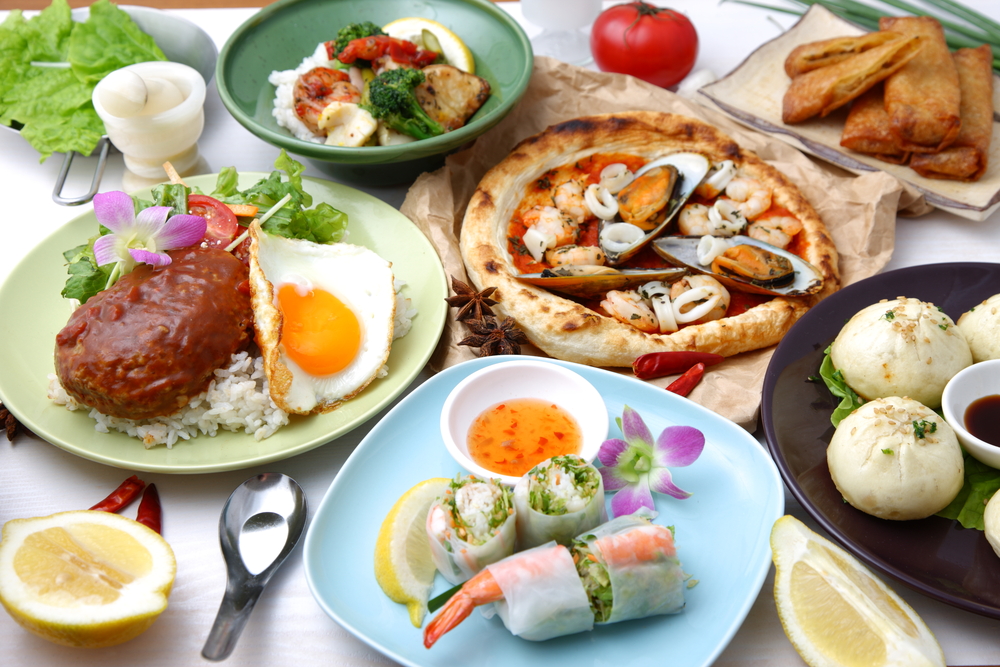
Show the Meals and snacks presentation, e.g. shepherd’s pie.


Look at each dish in turn and ask the children to identify a food in the dish and the food group to which it belongs. Talk to the children about ingredients which may be in the dish but cannot be seen, e.g. oil (for cooking), spread (in sandwiches).


For example:

Dish Fruit and vegetables Potatoes, bread, rice, pasta and other starchy carbohydrates Beans, pluses, fish, eggs, meat and other proteins Dairy and alternatives Oil and spreads

Pizza

Tomato sauce

Bread base

Chicken

Cheese


Sandwich

Lettuce, Cucumber

Bread

Cheese


Spread

Shepherd’s  pie

Peas, Carrots

Potato

Lamb mince


Oil (cooking)

Task the children to find different meals and snacks in recipe books, magazines or on the internet and analyse them using the What is it made from? worksheet. The children could also use the World food cards for this activity.


When the children have finished the task, ask them to share some of the meals and snacks they have found, state the ingredients they contain and where they belong on the Eatwell Guide.


Summarise that most of the meals and snacks we eat contain food from more than one food group.  This helps us to have the different types and varieties of food we need for health.

Show the Eatwell Guide image on the Eatwell Guide presentation 7-11 or the Eatwell Guide poster. Discuss the size of the different food groups and what this means. Take each group in turn and question the children:

  • Is this a large, medium or small group?
  • What size do you think this group is as a percentage or fraction?
  • How much of our diet do you think should come from food in this group?


Establish the following points about the groups:

Food group

This group should make up:

Messages

Fruit and vegetables

Just over 1/3 of the diet (39%)

Eat plenty, have at least 5 A DAY

Potatoes, bread, rice, pasta and other starchy carbohydrates

Just over 1/3 of the diet (37%)

Eat plenty, have food from this group with every meal

Beans, pulses, fish, eggs, meat and other proteins

Around 12% of the diet

Eat some every day, include two portions of fish a week, one of which is oily

Dairy and alternatives

Around 8%

Eat some every day

Oil and spreads

Around 1%

Use in small amounts and less often


Foods high in fat, salt and sugars – these foods are not needed in the diet.  If consumed, limit these and have them less often and in smaller amounts (no more than 3% of the diet).


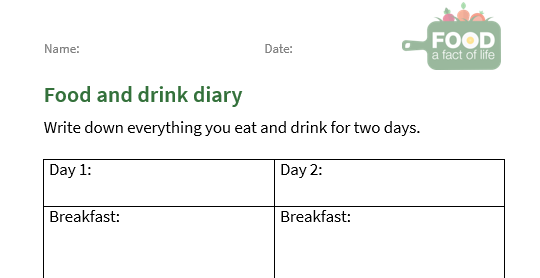
Explain to the children that they will keep a record of what they eat for two days to see if what they eat in this time is in proportion with the Eatwell Guide. They will also record their drinks to make sure they are having 6-8 drinks a day. The children can record this on the Food and drink diary worksheet. Print copies or display the Eatwell Guide poster for children to refer to as they complete this task. Summarise that the Eatwell Guide shows how much of what we eat overall should come from each food group. This means that if we set out all the food we ate over a few days or a week it should be in the proportions shown on the Eatwell Guide (as described in the table above).


If you think the children may find it difficult to know where the food they eat belongs, you may like to provide copies of the Eatwell Guide food list. This lists a variety of foods found in each group, in addition to those represented by images on the Guide.


Once the children have completed their Food and drink diary worksheet, discuss how what they ate and drank over two days compares to what is shown on shown on the Eatwell Guide.

  • Did most of the food you ate come from the Fruit and vegetables and Potatoes, bread, rice, pasta and other starchy carbohydrates food groups? Around a 1/3 from each group?
  • Did you have some foods from both the Beans, pulses, fish, eggs, meat and other proteins and Dairy and alternatives groups, with slightly more coming from the Beans, pulses, fish, eggs, meat and other proteins?
  • Did you have just a small amount from the Oil and spreads group?
  • Did you have 6-8 drinks each day?
  • Did you have either no Foods high in fat, salt and sugars, or just a little?
  • Do you think you should be eating more/less from any of the groups?

Summarise that it is OK if our diet is not in the exact Eatwell Guide proportions every day, but we should try to be in these proportions over a few days or a week or so to make sure we are getting the balance and variety of food our body needs to stay healthy.

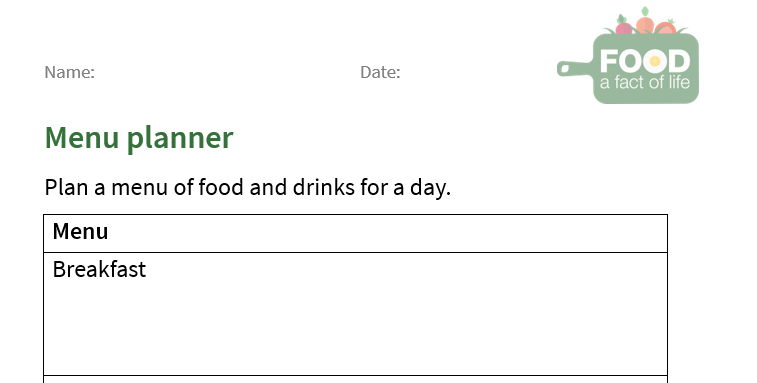
Task the children to work in pairs to devise a menu showing food and drink for a day that reflects the Eatwell Guide. You could provide images and recipe books for inspiration. Use the Menu planner worksheet and the Eatwell food list worksheet.


When the children have finished, ask them to share their menus and consider these alongside the Eatwell Guide.

Further activities

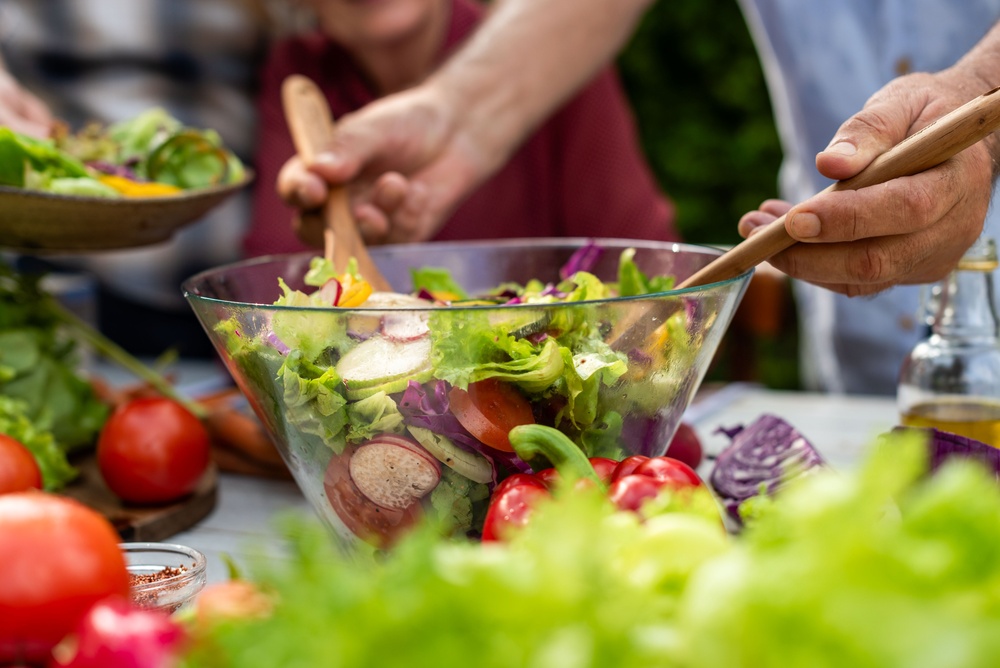
  • Make some dishes with the children and talk about where the food in them belongs on the Eatwell Guide, e.g. sandwich, salad.
  • Research restaurant menus and sort the food into the Blank Eatwell Guide to check the portions of food included from each food group.

Resources for 7-11 Years

Activity packs for 7-11 years

Take a look at our Activity packs for learners aged 7-11 years. The packs comprise food themed resources around topics such as Harvest festival, Space, Bread and Victorians.


Eat well for 11-14 years

The lessons and resources below cover:

  • The Eatwell Guide
  • Applying the Eatwell Guide
  • The importance of being well hydrated

You will also find video and interactive resources to help embed the learning in your classroom.

The Eatwell Guide

The resources and pupil activities below can be used to support teaching and learning about the Eatwell Guide. 


To introduce and explain the concept of the Eatwell Guide, show the pupils the introductory Eatwell Guide video. Challenge the pupils to create a poster or information guide to explain the Eatwell Guide. Use the pupil’s work to create a classroom display.


To investigate the key messages and the foods which are included in each group of the Eatwell Guide in more detail, show the pupils The Eatwell Guide presentation. Task the pupils to complete The Eatwell Guide worksheet.


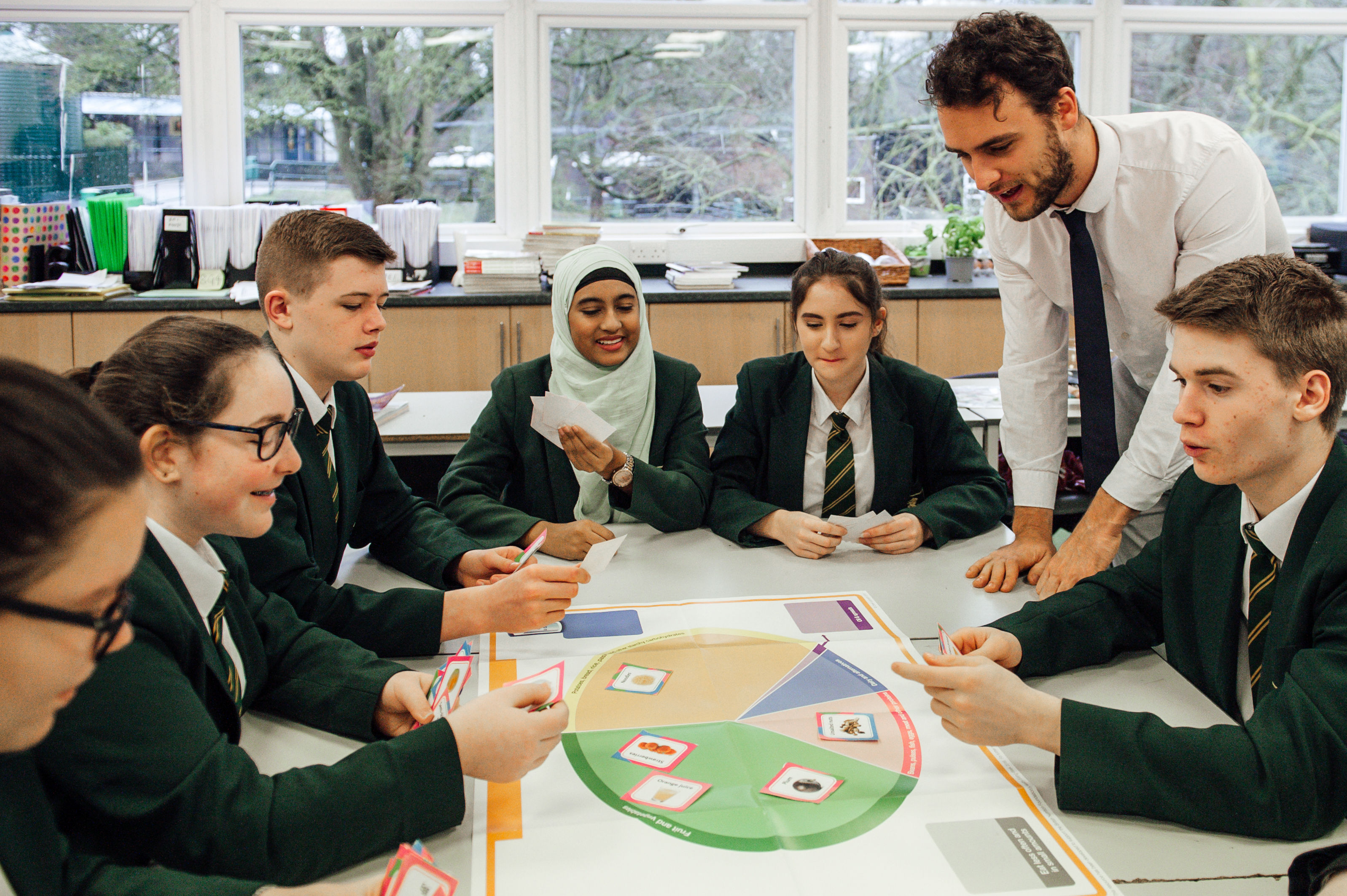
To consolidate learning, provide the pupils with a The Eatwell Guide blank worksheet and a set of The Eatwell Guide food cards. Working in pairs, ask the pupils to sort the cards and place them in the correct food group on the blank Eatwell Guide.


Task the pupils to see how well they are meeting the healthy eating guidelines. Give them the My diet worksheet to complete. They can then analyse how well they met the guidelines over this period of time. What changes, if any, do they need to make to meet the guidelines?


To establish the pupils understanding of the principles of the Eatwell Guide ask them to complete the Eatwell Guide circle map.


Use the Eatwell Guide quiz as an interactive way to test pupil knowledge of the Eatwell Guide. The Eatwell Guide Kahoot Q&A will support this activity. 


To enable the pupils to apply their knowledge, ask them to plan and make a dish which would provide at least two portions of fruit and vegetables and use potatoes, bread, rice, pasta and other starchy carbohydrates


Show the pupils the Making better choices with the Eatwell Guide podcast to further enhance their knowledge of the Eatwell Guide. Challenge the pupils to create their own short video or podcast which could be shared with the school community and parents/carers via your school website.


Use the interactive Eatwell Guide game to test the pupil’s knowledge of the different food groups.


Discuss portion sizes for fruit and vegetables – have some examples ready and ask the pupils to estimate how much of each food would be a portion. Weigh 30g of dried fruit. Compare this with the amount found in dried fruit snack bags or boxes. Ask the pupils why 30g of dried fruit counts as a maximum of one portion a day.


Ask the pupils why one 150ml glass of fruit juice or smoothie counts as a portion per day. Challenge the pupils to pour the amount of juice that they would drink into a glass (this could be plain water or water coloured with food colouring). Then ask them to pour the liquid into a measuring jug and see how it compares with the 150ml glass recommendation.

Eatwell Guide resources

Applying the Eatwell Guide

Scroll through for resources and activity ideas about applying the Eatwell Guide:

 loading=

Challenge activities


Challenge the pupils to apply their knowledge of the Eatwell Guide. Introduce the 8 tips for Healthy Eating by showing the 8 tips for healthy eating presentation and ask the pupils to complete the 8 tips for healthy eating worksheet.


To develop and apply their knowledge of the main food groups the pupils can be challenged to undertake a series of activities:


Click the arrows to see more!

 loading=

Potatoes, bread, rice, pasta and other starchy carbohydrates:


Show the pupils the short Eatwell Guide video to revisit the key points about this food group.


Discuss the importance of wholegrain, higher fibre foods and how they can be included in a healthy, varied diet. Ask the pupils to work in pairs to plan the meals for a day for themselves, highlighting the main sources of fibre. Use a nutritional analysis programme such as Explore food to analyse the meals.


Have printed or electronic copies of the Fantastic fibre! diet diary for each pupil. Ask them to complete the diary and to identify how they could make any changes, if needed, to increase their fibre intake.


If time and facilities allow, ask the pupils to create a dish that includes a starchy carbohydrate as a main ingredient. This could be an opportunity to use some wholegrain ingredients that are less familiar to the pupils e.g. starchy vegetables, bulgur wheat, millet, sorghum, quinoa, cornmeal, oats, barley and rye.

 loading=

Fruit and vegetables


Two of the 8 tips for healthy eating are: Eats lots of fruit and vegetables and Don’t skip breakfast. Discuss with the pupils what counts as a portion of fruit and vegetables and how they can be included in the diet. You may wish to review the 5 A DAY message; show the pupils the 5 A DAY presentation and follow up with challenging the pupils to show they could include at least 1 portion of fruit and/or vegetables in their breakfast.


Give out the Do you know your 5 A DAY? worksheet to the pupils working in small groups. Ask them to discuss and fill in the answers. Take feedback from each group and identify where any further explanation is needed.


Breakfast is an important meal but is often not eaten for a variety of reasons. Discuss with the pupils why this might be the case.


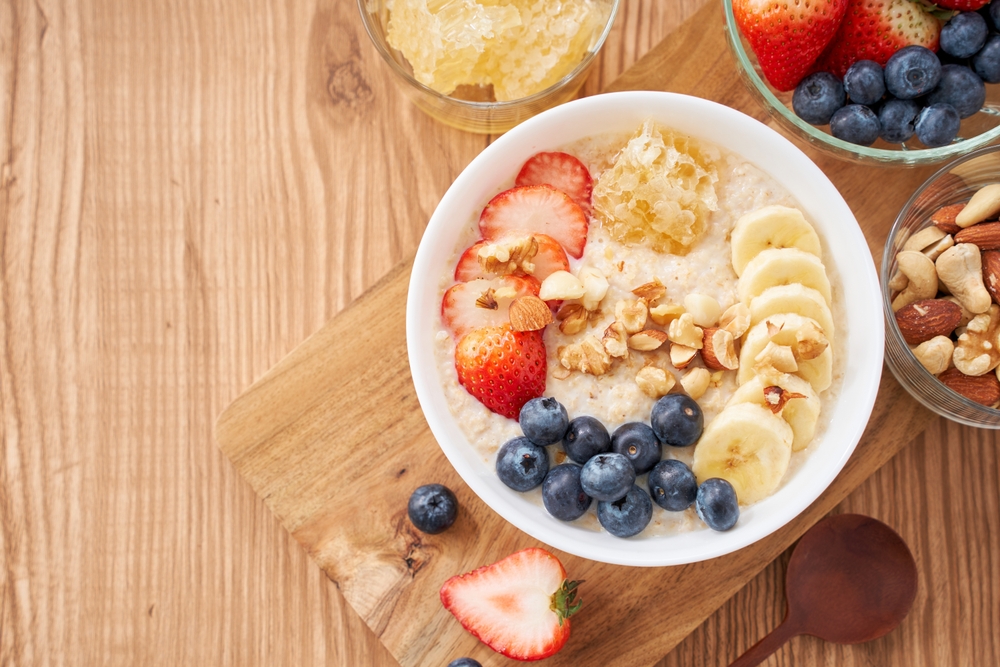
Challenge the pupils to investigate different ideas and recipes for breakfast that include starchy carbohydrates and at least one portion of fruit or vegetables.


If time allows plan a lesson for the pupils to prepare and make a breakfast dish that includes fruit and/or vegetables.

 loading=

Beans, pulses, fish, eggs meat and other proteins


Show the pupils a variety of beans and pulses, discuss the benefits of eating them regularly, e.g. they are a cheap, low-fat source of protein, fibre, vitamins and minerals and count towards your 5 A DAY.


Use the Multi-cultural cooking with beans and pulses worksheet to research the use of beans and pulses around the world. If time allows, challenge the pupils to make one of the recipes they found during the research task.


Discuss the safe use of beans and pulses with the pupils, ensuring they are aware that dried beans, but in particular kidney and soya beans, must be soaked for at least 12 hours, drained and washed and then boiled vigorously for 10 minutes and then simmered for 45-60 minutes to make them tender.

 loading=

Dairy and alternatives


Carry out a sensory evaluation activity using milk (whole, semi-skimmed, 1% fat, skimmed) and dairy alternatives. For information and resources about sensory evaluation, go to the Sensory evaluation area.


Dairy alternatives are substitutes for people who are lactose intolerant or allergic to dairy. Discuss with the pupils the range of alternatives available and highlight the importance of drinking fortified and reduced sugar versions as recommended by the Eatwell Guide.


The Eatwell Guide also recommends that lower fat versions of dairy products should be chosen. Challenge the pupils to consider lower fat varieties of cheese by using the Rank cheese in order of fat per 100g activity.


Challenge the pupils to make a cheese sauce using standard grated cheese and another cheese sauce using a smaller amount of mature or extra strong grated cheese. Carry out a sensory evaluation of the two cheese sauces and also a nutritional analysis, using a nutritional analysis programme such as Explore food. Compare the flavour, texture and fat content of the two sauces.

 loading=

Recipe Modification


Recipe modification is an important skill for pupils to learn. Discuss the implications of changing ingredients, proportions and cooking methods.


Provide electronic or printed copies of the Recipe modification worksheet. Ask the pupils to apply the principles of the Eatwell Guide and the 8 tips for healthy eating to complete the worksheet. If time allows, plan a practical lesson for the pupils to work in pairs to make one of the original recipes and one with the added ingredients to increase the fibre.


The pupils could then complete a sensory evaluation and/or a nutritional analysis of the two dishes to compare the sensory properties and nutritional profiles.


Challenge the pupils to come up with a health pledge which could be about diet or physical activity. A health pledge is a statement of a positive change that someone promises to make about their health. An example of a health pledge could be ‘I am going to eat at least 5 portions of fruit and vegetables a day’. Question pupils on how they plan to achieve this pledge e.g. having a portion with every meal and as snacks. Pupils could make a class display of their pledges.

Applying the Eatwell Guide resources

The importance of being well hydrated

The resources and pupil activities below can be used to support teaching and learning about hydration. 

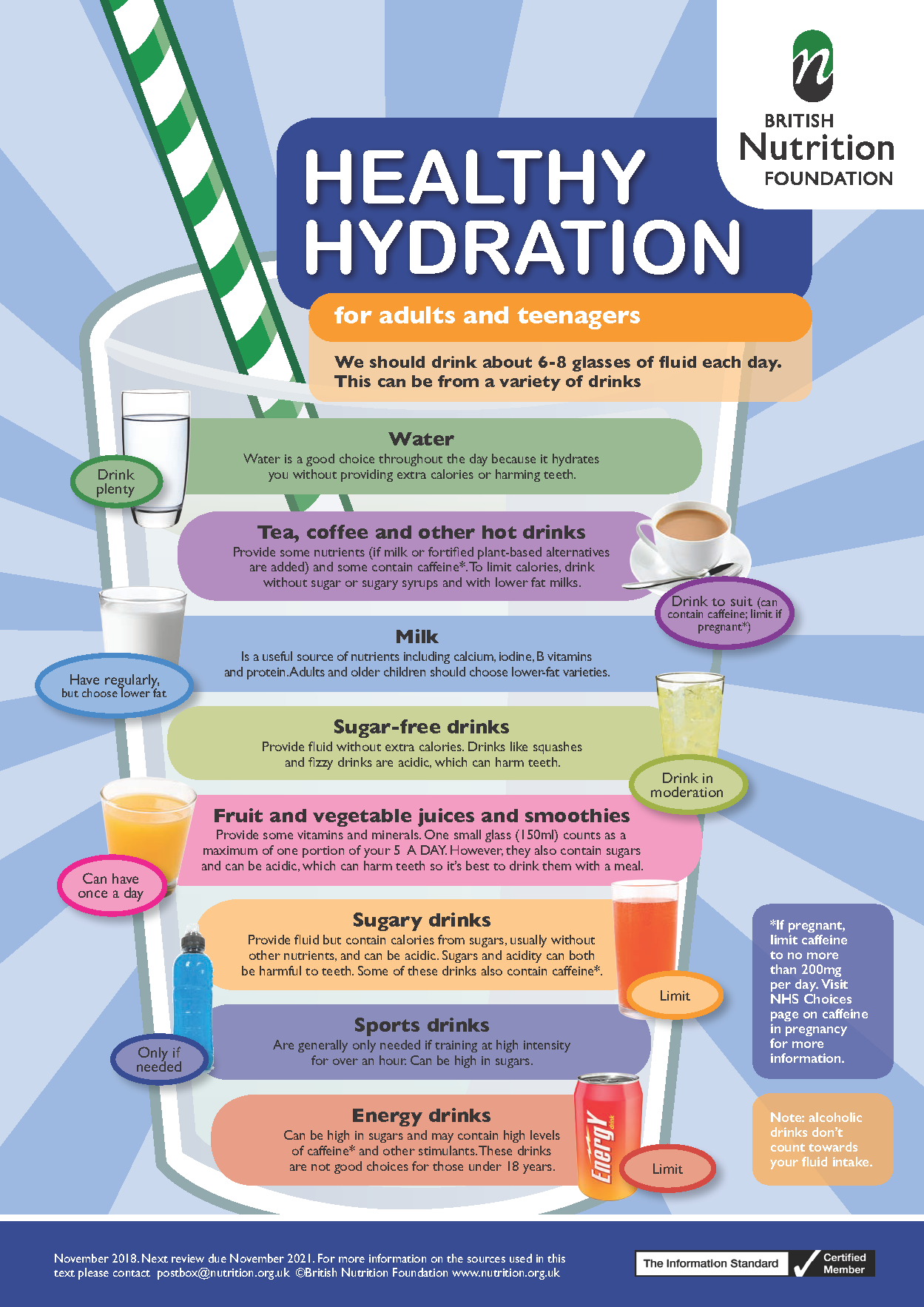
  • Using a poster or a print out of the Eatwell Guide, ask the pupils about the Hydration message in the Guide, where do they see it and what are the key messages? Show the Hydration video to give a useful overview of the importance of hydration.
  • Use the Hydration presentation to explain the importance of water. Ask the pupils to complete the Hydration worksheet. Discuss with the pupils why water is so important in daily life and how reduced water intake/dehydration can affect their ability to learn and concentrate.
  • Challenge the pupils to complete the Hydration Kahoot quiz. Discuss the answers they have given using the Hydration Kahoot quiz answers.
  • The Healthy hydration BNF poster is available as a useful teacher/adult resource and can be used as part of a display on healthy hydration.
  • Distribute printed copies of the Healthy hydration handouts to small groups of pupils. Ask them to complete the answers for the drink on their card; share the answers with the class. What are the benefits and disadvantages of some of the drinks?
  • Challenge the pupils to create a display or presentation for other pupils providing information about the amount and type of drinks they should be consuming. You may wish to include the topic of ‘energy drinks’ and sugar consumption.
  • Task pupils with creating a leaflet to provide to other pupils and staff in the school about the importance of hydration and healthy drink choices. Pupils should use reliable sources of information to create their leaflet, e.g. government health department websites or textbooks.

Hydration resources

Eat well for 14-16 years


The Eatwell Guide

The resources and pupil activities below can be used to reinforce prior learning about the Eatwell Guide and applying this in everyday life.

  • Analyse a range of fictional one-day diets and assess how well they reflect the Eatwell Guide, suggesting realistic improvements where appropriate.
  • Evaluate a selection of meals against the Eatwell Guide and explain how they could be adapted to improve their nutritional balance.
  • Design a main meal for a specific target consumer that reflects the principles of the Eatwell Guide and justify your ingredient choices.
  • Modify an existing recipe to increase fibre, fruit and vegetables or reduce fat, salt or free sugars, and evaluate the impact of the changes.
  • Compare different meals and identify how the choice, variety and proportion of foods contribute to a balanced diet.
  • Plan a balanced meal within a set budget, considering the Eatwell Guide, nutritional value, cost and practical preparation.

Resources for 14-16 Years

Did you find this page useful?

We'd love to hear your feedback. If you would like a response, please contact us at [email protected]